Research Paper Rejections Explained: What Students Need to Know
Submitting a research paper is often the most stressful stage of the academic journey. Many students and early researchers put in significant effort, yet still face rejection from journals, conferences, or supervisors. This experience can feel discouraging, especially when the reasons for rejection are not clearly understood.
In most cases, research papers do not fail because the topic is unimportant or the author lacks ability. Papers are rejected mainly due to structural, methodological, and presentation-related issues that can be avoided with proper understanding and guidance.
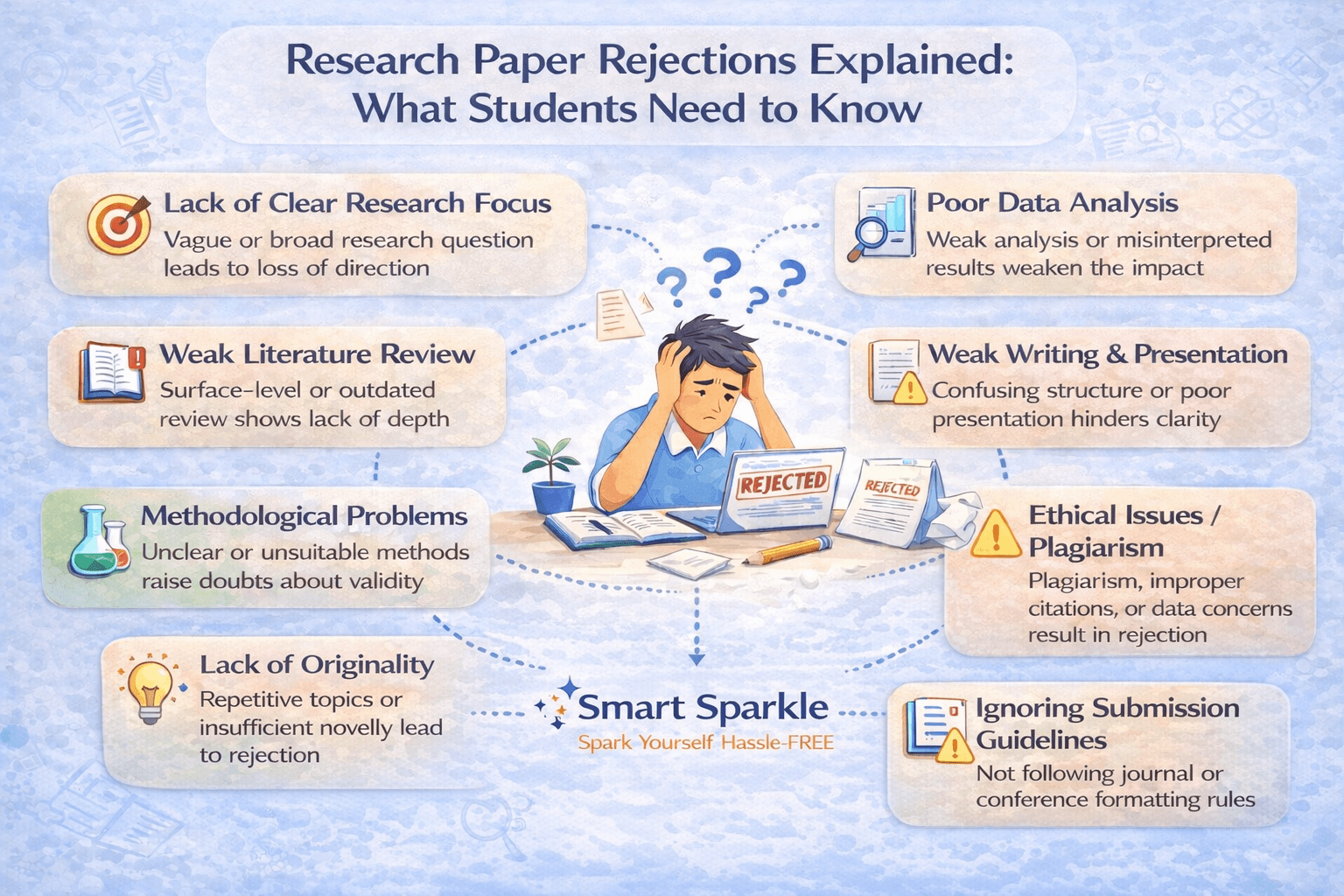
📌Lack of Clear Research Focus
One of the most common reasons research papers fail is the absence of a clear and focused research problem. When the research question is vague or too broad, the entire paper loses direction.
Reviewers often reject papers that do not clearly state what problem is being addressed and why it matters. Without a strong focus, even good data and writing fail to create impact.
📚Weak or Improper Literature Review
A research paper must demonstrate awareness of existing studies. When the literature review is poorly written, outdated, or overly descriptive, reviewers may conclude that the research lacks depth.
Common issues include summarizing sources without analysis, failing to connect past studies with the current research, or relying on unreliable references. A weak literature review reduces the academic credibility of the paper.
🧪Methodological Problems
Methodology is the backbone of any research paper. Papers are frequently rejected when the chosen methodology does not align with the research objectives or is not explained clearly.
If reviewers cannot understand how the research was conducted or why a specific method was chosen, they may question the validity of the results. Methodological confusion is a major reason for rejection.
📊Poor Data Analysis and Interpretation
Even when data collection is done correctly, many papers fail at the analysis stage. Inadequate statistical methods, incorrect interpretation of results, or lack of justification weaken the paper significantly.
Research findings must be clearly explained and directly linked to the research questions. Unsupported conclusions or vague discussions often lead to rejection.
📝Weak Writing and Presentation
Clarity in writing is essential for communicating research effectively. Papers with poor structure, unclear arguments, grammatical errors, or inconsistent formatting often create a negative impression on reviewers.
Academic writing should be clear, concise, and logically organized. Even strong research can fail if it is not presented properly.
⚖️Ethical Issues and Plagiarism Concerns
Ethical standards play a critical role in research evaluation. Papers that show signs of plagiarism, improper citation, or data manipulation are often rejected immediately.
Many students struggle with correct paraphrasing and referencing styles, which can unintentionally raise ethical concerns. Maintaining academic integrity is essential for successful publication.
⏳Ignoring Submission Guidelines
Every journal or conference has specific submission guidelines related to formatting, word limits, citation style, and structure. Ignoring these requirements is a common but avoidable mistake.
Reviewers often reject papers that do not follow basic guidelines, regardless of research quality. Attention to detail is crucial at this stage.
🌱Rejection Is Part of the Research Process
Rejection does not mean failure — it is often part of the learning process. Even experienced researchers face rejection multiple times before successful publication.
Understanding why papers are rejected helps students improve their work, refine their skills, and grow as researchers. Feedback from reviewers can be valuable when used constructively.
✨Smart Guidance Makes the Difference
At Smart Sparkle, we support students and researchers by helping them improve research quality, methodology clarity, writing structure, and ethical compliance. Our goal is to reduce avoidable mistakes and help learners submit research with confidence.
Research papers fail or get rejected not because of lack of effort, but because of common and correctable issues. Clear focus, strong methodology, proper analysis, ethical practices, and careful presentation significantly increase the chances of acceptance.
Understanding these factors is a crucial step toward successful research publication and academic growth.
Smart Sparkle — Spark Yourself Hassle-FREE